How Matchmaking Methods Shape the Meaning of a Good Fit
Matchmaking methods shape what counts as a good fit. Learn how introductions, preference lists, and profile cards frame compatibility—and what to ask next.
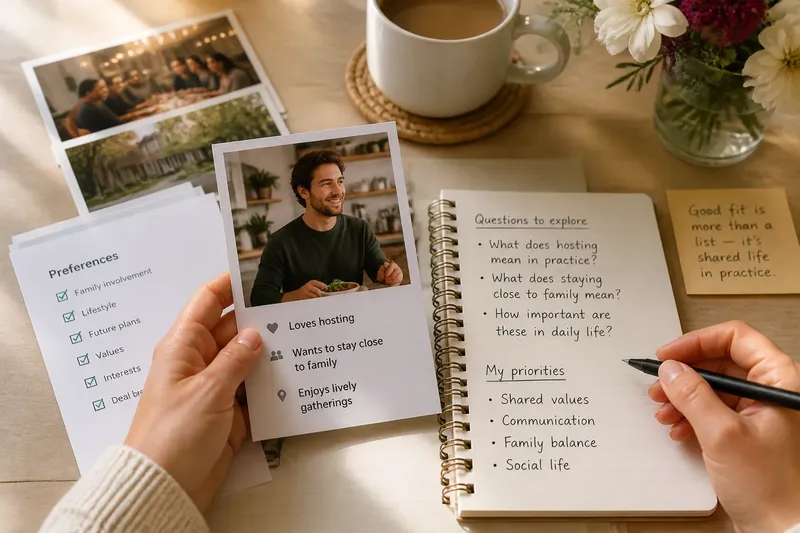
At a family dinner, an aunt introduces two guests by mentioning their shared love of hosting and their different ideas about living near relatives. That matchmaking introduction offers context, but it also reflects the aunt’s judgment about what matters. Matchmaking methods shape what people notice when they assess a potential partner, long before they can judge how they relate in conversation.
The useful question is not which format reveals the “real” person. It is what each method selects, what it leaves uncertain, and how its compatibility claims should be interpreted.
Introductions and judgment
A personal introduction connects people through someone else’s knowledge and choices. The introducer may explain why a match seems promising: perhaps both enjoy a busy household, or one person values frequent family visits while the other is comfortable with that arrangement.
This method makes room for context that a short form cannot easily capture. Someone can clarify what “outgoing” means in practice, or say that a promising detail is only a guess. But the introducer’s view is not neutral. They may emphasize what relatives value, rely on incomplete information, or assume that two people’s similar habits will make them compatible.
So treat an introduction as a reason to meet or ask questions, not as a verdict. Its strongest contribution is often a specific point to explore, rather than a prediction about the relationship.
Preferences and priorities
Some matchmaking methods begin with stated preferences: desired qualities, lifestyle choices, family expectations, or plans for the future. A preference is a person’s expressed wish; it is not automatically a measure of how well two people will manage daily life together.
Lists can help separate firm requirements from attractive extras. Wanting children, for instance, may be a central life direction for one person, while preferring a partner who shares a particular hobby may be flexible. The distinction matters because a matching method can make every answer look equally important even when the person who supplied it does not.
Ask what a preference means in ordinary circumstances. “Close to family” could mean regular calls, frequent visits, or living nearby. The phrase alone does not tell you which interpretation applies, or whether the person is open to another arrangement.
Profiles and compression
A profile card or short online profile places selected details side by side: perhaps location, interests, a photograph, and a few sentences. This makes it easier to scan and compare potential matches. It also gives visible fields more weight than qualities that are harder to summarize, such as how someone handles disagreement or changes plans.
Compression creates ambiguity. A hobby may be listed without saying how central it is; a blank field may reflect limited space rather than a deliberate omission. Readers can mistake a neat layout for a complete assessment, even though the format presents only chosen information.
Photographs also frame first impressions. A portrait or a snapshot in a kitchen shows a particular image and setting, not a dependable account of character. Notice the impression, but keep separate what the photograph shows from what you infer.
Matching claims examined
A matchmaking service may describe its method as compatibility-based, preference-led, or designed to identify shared values. Those labels tell you how the service presents its approach; on their own, they do not explain how it weighs answers or what “compatible” means in practice.
Useful questions focus on the method’s inputs and limits. Does it prioritize stated preferences, shared interests, or a matchmaker’s judgment? Can people explain or revise an answer? Are suggestions meant to identify conversation starters, or are they presented as a stronger prediction? Clear answers help you assess the claim without treating a score, label, or introduction as proof of future compatibility.
It is not worth trying to decode every missing profile detail as a hidden signal. A gap can come from the format, an individual choice, or simple oversight. Concentrate on the information that bears on your own priorities, then ask directly about the uncertainties that could affect a shared life.
Questions worth asking?
Is a shared interest evidence of compatibility?
It can provide an easy way to connect, but it says little by itself about how people handle differences or make decisions. Ask what the interest means to each person and whether it has a role in their everyday routine.
How should I read a compatibility score?
First find out what information the method uses and what the score is intended to represent. Treat it as one input for deciding whom to learn about, not as a substitute for conversation or judgment.
What does a matchmaker know about a potential match?
A matchmaker may know details shared by the people involved and may add personal impressions. Ask which information is directly stated and which is the matchmaker’s interpretation, especially when a recommendation rests on a broad label such as “family-oriented.”
A worked comparison
Say you receive a profile for Jordan that lists “loves hosting” and “wants to stay close to family.” You also hear from a mutual friend that Jordan is thoughtful and prefers a lively home. Those are the starting inputs: two profile phrases and one person’s impression. They offer possible topics, but neither source defines the phrases or confirms that your expectations align.
First, separate observation from interpretation: the profile states an interest in hosting and a preference about family proximity; the friend supplies a character description. Next, identify the questions that could change your assessment: does hosting mean occasional dinners or frequent gatherings, and does staying close mean regular visits or living nearby? Then ask Jordan for examples if a conversation develops. If the answers fit your own needs, the introduction may be worth pursuing; if they reveal a conflict over family involvement or social life, you have a concrete point to consider. The result is a clearer decision based on stated priorities, not a claim that the formats predicted a good match.
- Observation: A preference is described as essential. If it concerns a major life direction you share, then ask what it means in practice; if it is unclear, then avoid treating it as settled agreement.
- Observation: A preference appears alongside casual interests with no sign of priority. If the distinction affects your decision, then ask which items are firm; if it does not, then treat the list as conversation material.
- Observation: A profile uses a broad label such as “ambitious.” If its meaning matters to you, then ask for an ordinary example; if no conversation is possible yet, then leave the meaning open.
- Observation: A photograph suggests a setting or mood. If you are curious about the scene, then ask about it respectfully; if you are drawing a character conclusion, then set that inference aside.
- Observation: A matchmaker offers a recommendation without explaining its basis. If the reasoning could affect your choice, then ask what information supports it; if the basis remains unclear, then treat the recommendation as a lead rather than evidence.
- Observation: Two profiles share a hobby but differ on an important stated priority. If the priority is non-negotiable for you, then give it more weight than the shared hobby; if its importance is uncertain, then clarify your own preference before deciding.
Matchmaking methods shape how a potential partner is presented, not the full relationship that might follow. Read compatibility claims through their inputs, distinguish a person’s stated priorities from someone else’s interpretation, and use each format to identify the next useful question.